THE AGENDA TO
CHANGE OUR CONDITION
A Prophetic Path To Profits, Power & Progress
THE BRIEF - BY THE MUSLIM CAPITALI$T
HOW WE START
(In The Name Of Allah, The Entirely Merciful, The Especially Merciful)
As Muslims, everything must start with the praise and remembrance of Allah (God). Without doing so the action we take thereon is maimed; however, by doing so, the action we take is blessed so long as the action is aligned with the values of Islam.
Before presenting this brief, I believe it is necessary to begin with intention.
This work, and the technology behind it, is for the sake of Allah alone. It is a humble effort to serve the Ummah by using the tools of this age to restore strength where there is weakness, connection where there is fragmentation, and dignity where there has been dependence. It is my attempt to use technology, strategy, and faith in a way that benefits Muslims now and, by Allah’s mercy, benefits me in the Hereafter.
This did not begin as a business idea. It began as a wound.
As a teenager, I was exposed to the reality of genocide through Bosnian Muslim families who had lived it. I could not understand how such brutality could happen to a people who belonged to an Ummah so vast, so rich in history, so full of people, wealth, and belief. That question stayed with me for years:
How could this happen to us?
Over time, I came to understand that our weakness was not simply the result of oppression. It was also the result of fragmentation, and fragmentation itself had become one of the conditions through which oppression succeeds.
“We were many, but not connected.
Present, but not coordinated.
Visible, but not organized.
Talented, but not routed toward one another.”
For years, I studied how other communities built strength through trust, coordination, economic circulation, and institutional loyalty. Eventually, by the mercy of Allah, I was able to understand that the deepest answers were not outside the scope of our religion at all. The solution was clearly already within it.
The Qur’an and Sunnah had already given us the principles. What we lacked was the infrastructure, discipline, and strategic application to operationalize those principles in the digital world - a world in which the majority of believers and mankind spends most of their time. It is this understanding and years of research I hope to share with you with you through this brief.
If there is any good in it, it is from Allah. If there is any deficiency, it is from me.
Our strength lies in unity.
Our direction lies in our Deen.
And our condition will not change until we build the means to change it.
EXECUTIVE SUMMARY
We are living in an age where power has shifted.
Power no longer belongs only to those who control land, armies, or formal institutions. Increasingly, it belongs to those who control identity, networks, distribution, coordination, and the rails through which people, trust, and value move.
And in that world, the Muslim Ummah remains structurally weak.
-Not because we are too small.
-Not because we lack wealth.
-Not because we lack talent.
-But because we are fragmented.
Our identities are scattered across rented handles, fragmented links, and platforms we do not own.
Our mosques and organizations operate through disconnected tools, manual coordination, and weak digital infrastructure.
Our businesses, causes, and leaders are forced to rely on extractive systems that charge us to reach our own people.
This is not merely a communications problem.
It is not merely a branding problem.
And it is certainly not a lack-of-effort problem.
It is an infrastructure failure.
That is the condition that Mecca Digital (M.D) is built to change Insha-Allah.
M.D is a faith-rooted infrastructure designed to unify Muslims through:
• owned identity
• trusted stations
• searchable community maps
• routed opportunity
• recirculating economic rails
It begins with a simple but transformative idea:
Every Muslim should have digital identity and address of their own.
Every institution should have a trusted digital community network & map.
And every community should own their own rails to route information
to members.
This is not another app.
It is not another feed.
It is not another destination platform competing for attention.
It is the identity and routing layer that makes Muslim people, institutions, services, and opportunities discoverable, trusted, and usable at scale. When mosques own the gate, the rails, and the map to their people, fragmentation becomes reversible, leaking capital becomes reroutable, and value can finally begin recirculating within the Ummah.
If we do not own our identity, we cannot own our map.
If we do not own our map, we cannot route our people.
If we cannot route our people, we cannot circulate value
or build real power.
THE PROBLEM:
FRAGMENTATION AT EVERY LEVEL
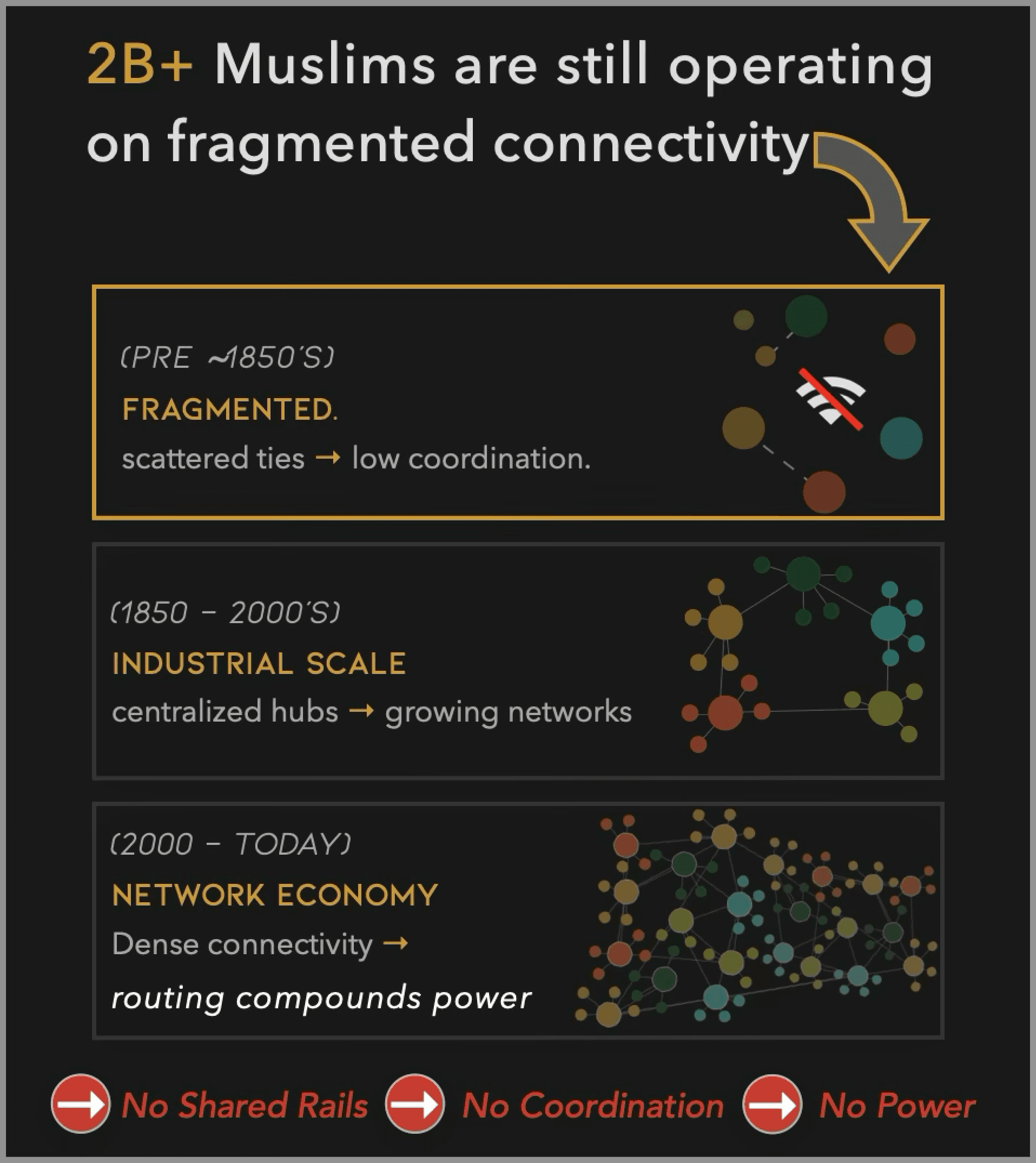
The Muslim condition in the digital age is not merely emotional, political, or cultural. It is infrastructural.
1. Fragmented Identity
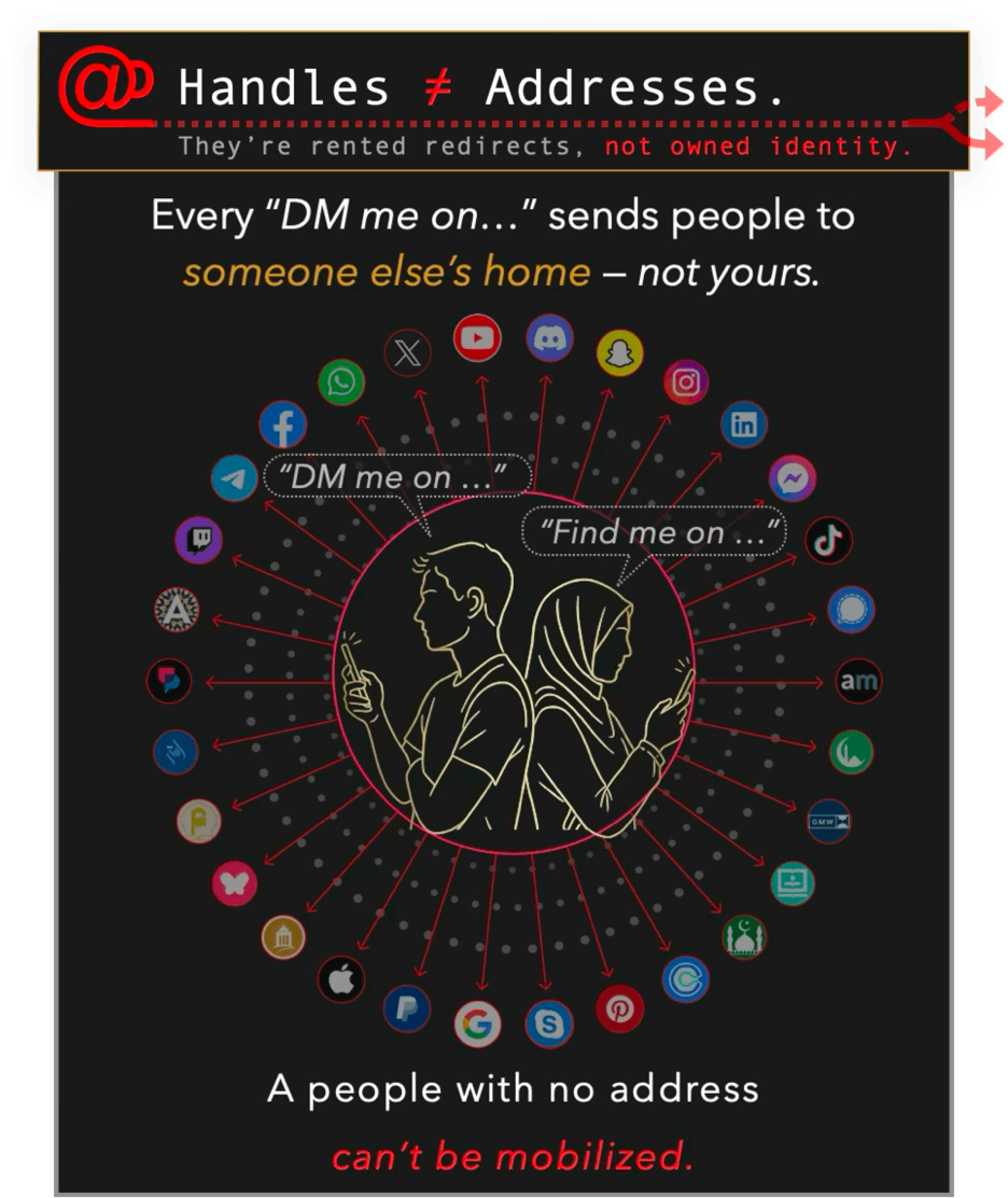
At the individual level, Muslims live behind scattered usernames, bios, links, and profiles spread across platforms that do not belong to them or serve their best interest;
A person may have:
• an Instagram handle
• a LinkedIn page
• a WhatsApp number
• an email address
• a booking page
• a donation page
• a website
• a dozen disconnected contact points
But they still do not have one trusted, permanent, portable address that unifies their digital presence in a single place they own and control.
This creates weakness and confusion, not sovereignty.
People become difficult to discover, difficult to verify, and difficult to route opportunities to. Their audience belongs to platforms, not to them. Their reach is rented. Their identity is fragmented, and they are used as the platform sees best.
2. Fragmented Institutions
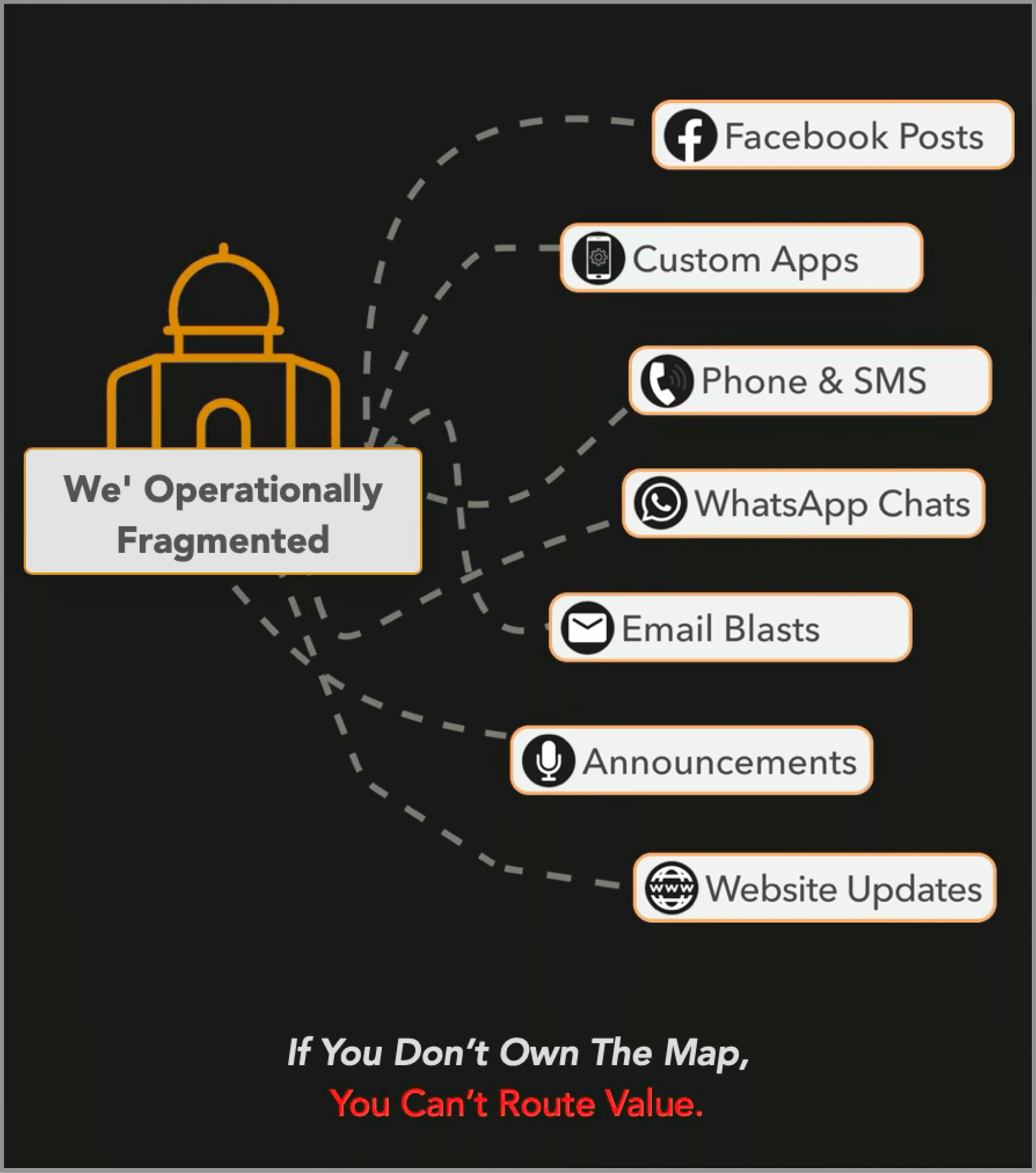
At the institutional level, mosques and Muslim organizations are forced to operate through a patchwork of disconnected tools:
• WhatsApp groups
• spreadsheets
• event tools
• newsletters
• donation platforms
• volunteer forms
• fragmented CRMs and contact lists
The trust exists offline.
The infrastructure does not.
This means every campaign starts from zero. Every outreach effort is manual. Every follow-up depends on scattered systems. Institutions have communities, but no true digital map of those communities.
3. Fragmentation-Tax
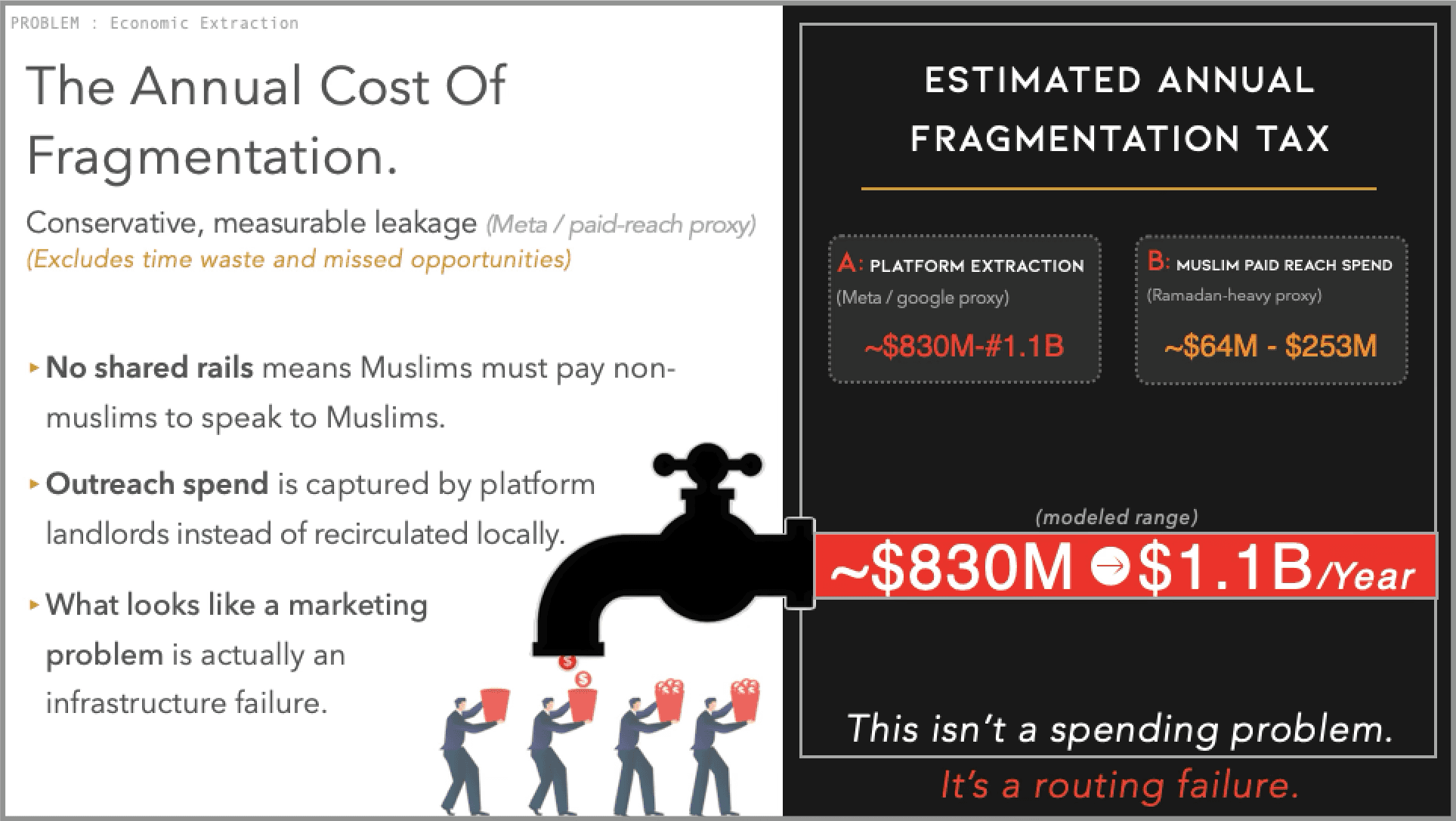
This fragmentation creates a real and measurable cost.
North American Muslim institutions and businesses already spend tens to hundreds of millions annually on digital promotion just to reach Muslims, while additional value is extracted by outside platforms through attention monetization and platform dependence. Conservative modeled leakage ranges from roughly $64M–$253M in direct paid reach spend, while broader annual extraction and leakage can reach approximately $830M–$1.1B+ under proxy models.
This is the Fragmentation Tax:
• the cost of disconnected identities
• the cost of disconnected tools
• the cost of disconnected markets
• the cost of having no shared rails of our own
4. Power Has Shifted
Today, power flows through:
• identity
• discoverability
• trusted access
• coordination
• routing
• network density
The communities that can identify, map, and route their people gain advantage.
The communities that cannot remain dependent, reactive, and vulnerable to extraction. As one of my earlier papers put it:
“We are one by command, but fractured by condition.
We are not weak because we are few.
We are weak because we are fragmented.”
THE SOLUTION:
IDENTITY, STATIONS & SHARED RAILS
Mecca Digital solves the problem in the correct order.
Step 1: Solve Identity First
The first and clearest problem is identity.
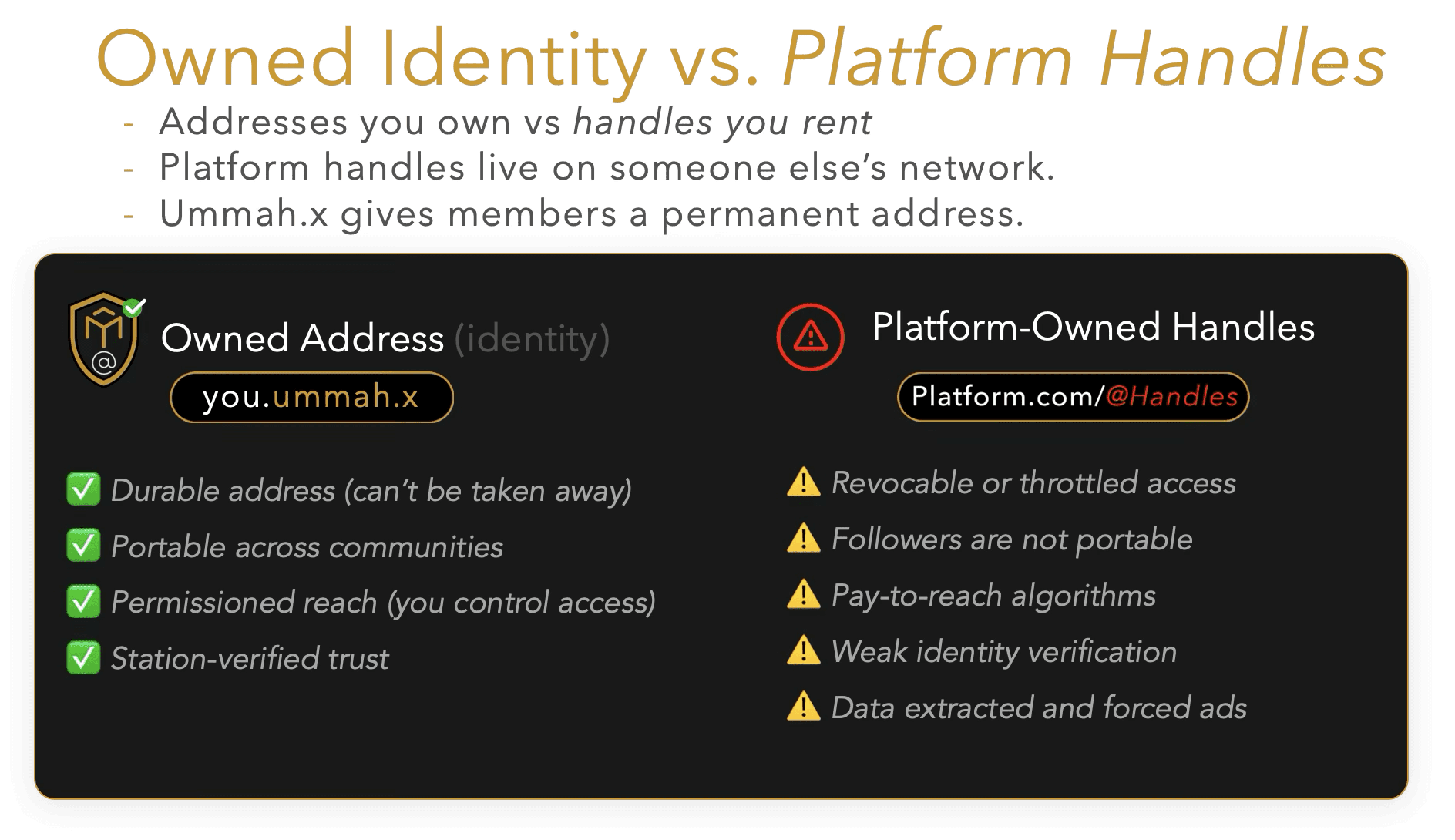
Every Muslim should have a permanent, trusted, owned digital address, a home base that belongs to them, not to a platform. This is the role of the Mecca Digital Passport.
The Passport functions as:
• an owned identity
• a link-in-bio replacement
• a professional and communal profile
• a portable networking tool
• a trusted digital address
It gives the individual one place to be found, understood, and routed through. For professionals, founders, creators, students, organizers, and influencers, this is immediately useful. It simplifies digital presence, improves discoverability, allows for unified communications, and creates a trusted identity hub for both online and offline use.
Step 2: Turn Trusted Institutions Into Distribution Hubs
Once identity is solved, the institutional problem can be solved.
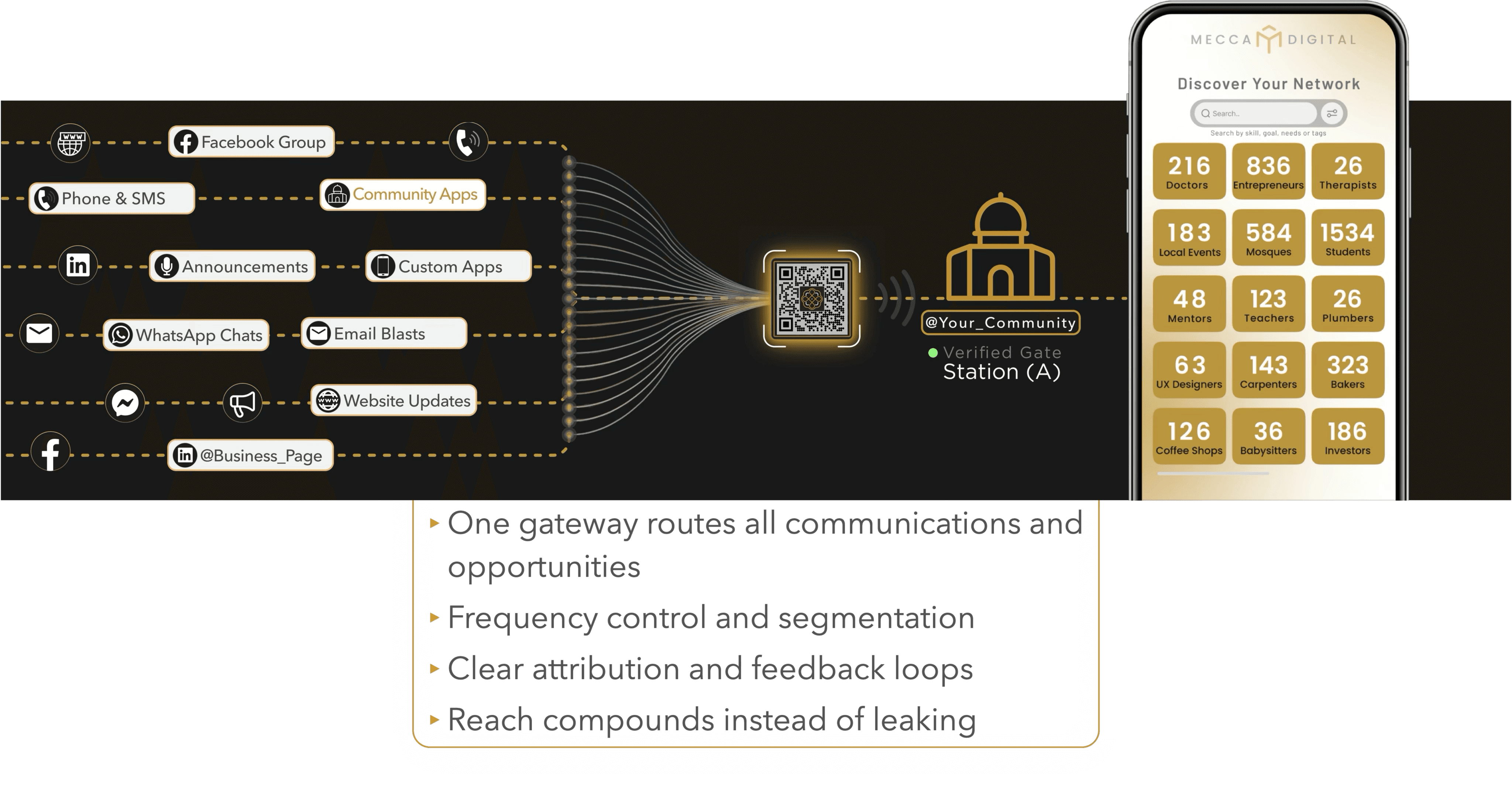
Mosques and trusted organizations become Verified Stations. Through QR/NFC gateways, real-world foot traffic is converted into a verified, searchable community roster.
This gives institutions:
• a trusted digital directory
• stronger communication
• cleaner segmentation
• unified communications & better follow-up
• better event conversion
• better volunteer and donor routing
• more efficient outreach
Instead of operating through scattered tools, the institution begins to operate through a real community graph. One scan turns offline trust into digital infrastructure. Members receive a verified owned identity. Institutions receive a searchable, routable community graph.
Step 3: Build Shared Rails / Infrastructure
As more Muslims claim identity and more institutions become stations, a broader network begins to form. This is where the real shift happens.
Value is no longer trapped in isolated apps & fragmented systems.
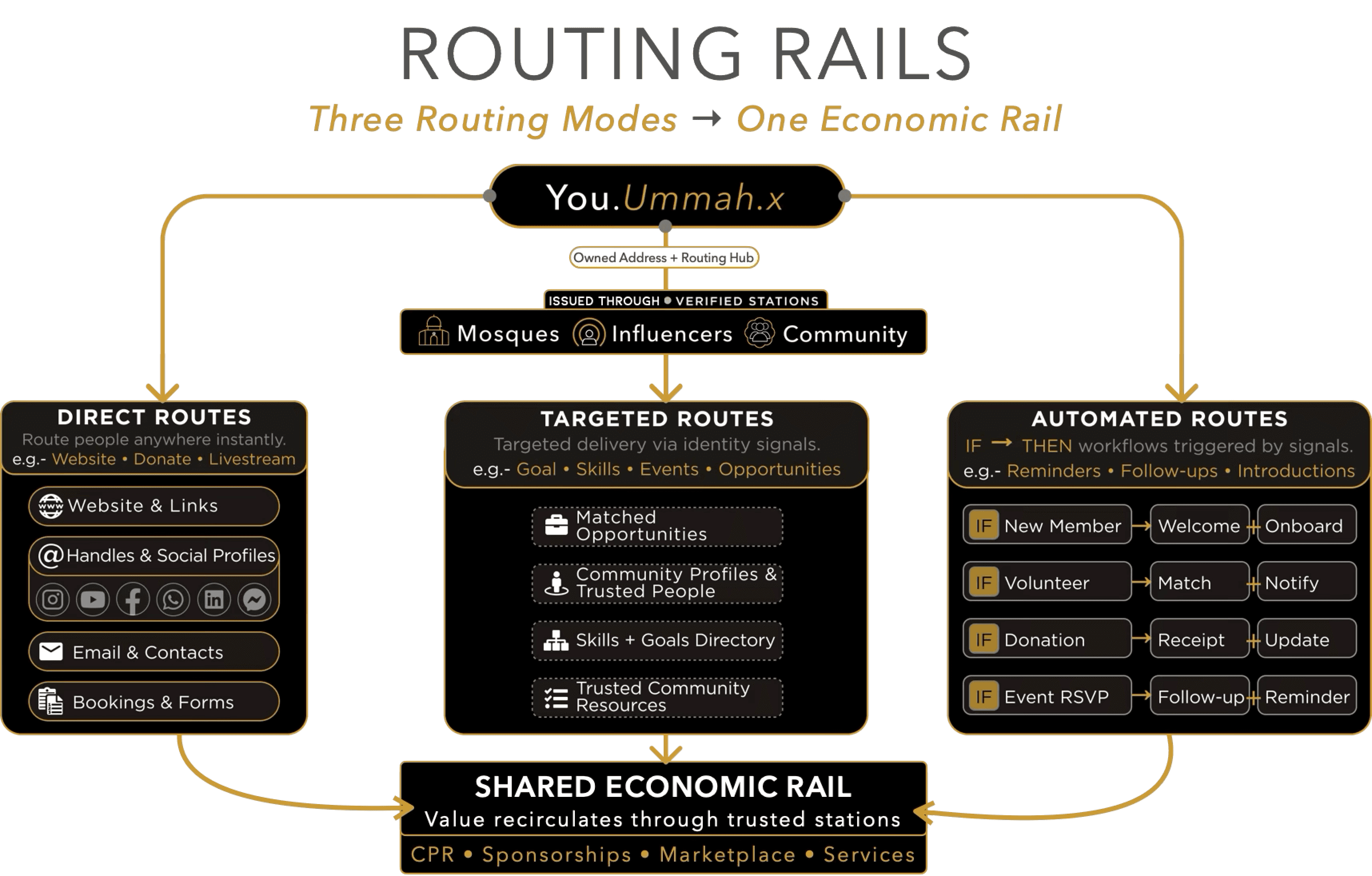
It can now move through shared rails:
• opportunities can be routed
• services can be discovered
• campaigns can circulate
• capital can be redirected
• trust can compound
This is exactly what the public-utility briefing captures so well: Mecca Digital is not a social feed, and it does not require rebuilding every tool. It is the identity and routing layer that makes existing tools, stations, and Muslim services usable at scale. It is the utility layer that allows us to quickly and efficiently recapture the hundreds of millions of dollars Muslims pay every year to outside platforms just to speak to their own community, and redirect that value back into the communities it came from.
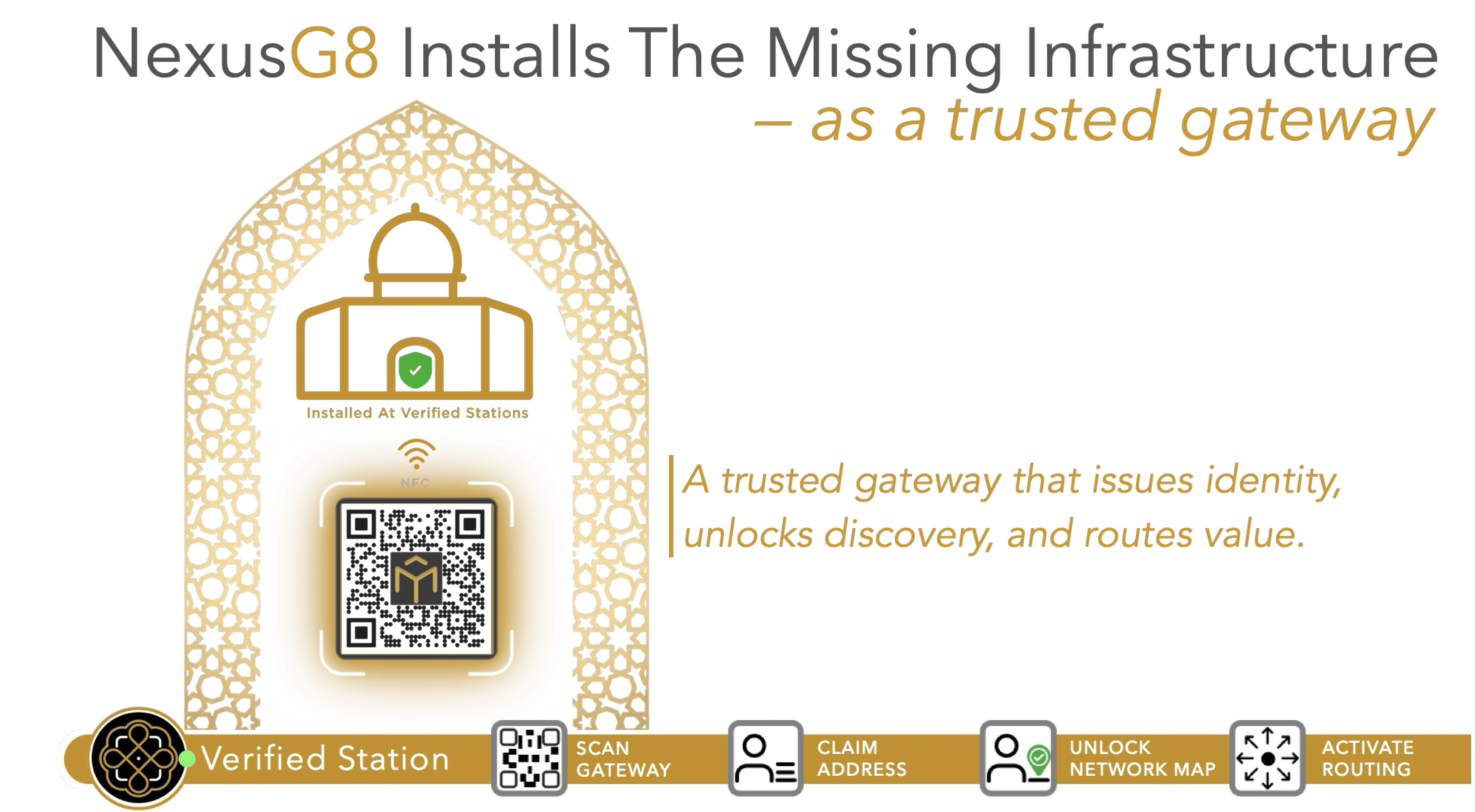
Step 4: Replace Extraction with Recirculation
Most platforms extract from communities.
This model is built to recirculate within them.
Rather than charging institutions to rent access to their own people forever, Mecca Digital is designed so that the value created by members and stations can begin flowing back into the very communities that make the network possible.
The model is explicitly waqf-minded: service-first, durable, and designed to circulate value inward rather than drain it out.
Identity is the entry point.
Stations are the distribution layer.
Shared rails are how value begins to circulate back into the Ummah.
WHY THIS WINS + THE INVITATION
WHY THIS WINS
1: It Solves the Problem in the Right Order
Most products start with features.
This starts with the root:
• identity first
• then institutions
• then routing
• then recirculation
That makes it easier to adopt, easier to explain, and easier to scale.
2. It Uses Trust That Already Exists
This system does not require inventing new communities.
The trust networks already exists with the institutions and people that are already serving our communities:
• mosques
• organizations
• events
• scholars
• influencers
• community leaders
What has been missing is not the development of more mosques, more people, or more institutions.
What has been missing is the infrastructure that connects them, coordinates them, and closes the gaps between them.
3. It Creates Value at Every Level
For individuals
A trusted identity, clearer discoverability, and a modern networking tool they actually own.
For institutions
Verified rosters, stronger communication, better coordination, greater resilience, and recurring upside.
For startups, builders, and investors
A faster way to find aligned talent, trusted collaborators, and values-aligned capital, reducing friction and go-to-market delays that come with a fragmented Muslim landscape.
For the broader Ummah
A growing identity layer, stronger routing, reduced dependence on outside platforms, and the beginning of recirculated value at scale.
4. It Aligns Purpose, People, and Profit
This is not technology for vanity.
It is infrastructure for coordination - built by the people.

Built to serve the community for the sake of Allah - not to extract from it.
Built to strengthen institutions - not displace them.
Built to circulate value - not drain it.
Built to protect identity - not dilute it.
Built to reduce echo chambers and outside interference - not deepen them.
Built to turn fragmentation into connection, and connection into coordinated power.
It is designed as a digital waqf because the infrastructure of a people should be governed like a trust for their benefit, not owned like a machine of extraction against them.
5. It Matches the Way Power Works Now
Power today belongs to those who can:
• identify their people
• map their people
• route their people
• coordinate their people
• retain the value their people create
• protect their people from erasure, throttling, and dependency
Mecca Digital is designed to do exactly that.
It creates an owned and portable identity layer that remains intact even when oppressive platforms shadow ban, throttle, suspend, or delete accounts.
If the address is ours, the network is no longer hostage to their systems.
It also functions as the least invasive form of infrastructure:
A true connective layer that does not require people to abandon their existing tools, routines, or institutions. Instead, it makes what already exists more discoverable, more trusted, and more usable at scale.
And because it connects purposeful people to what they are already seeking, through trusted gateways and intelligent routing, it can dramatically accelerate the formation of startups, teams, collaborations, investments, and opportunities across the Muslim world.
What you are looking for is also looking for you.
This infrastructure makes that connection possible.
And when those connections happen at scale, with less friction and more trust, immense amounts of capital, talent, and value can begin recirculating with far less effort than anything we have seen before.
That is what makes this scalable.
That is what makes it strategic.
And that is what makes it urgent.
The Invitation
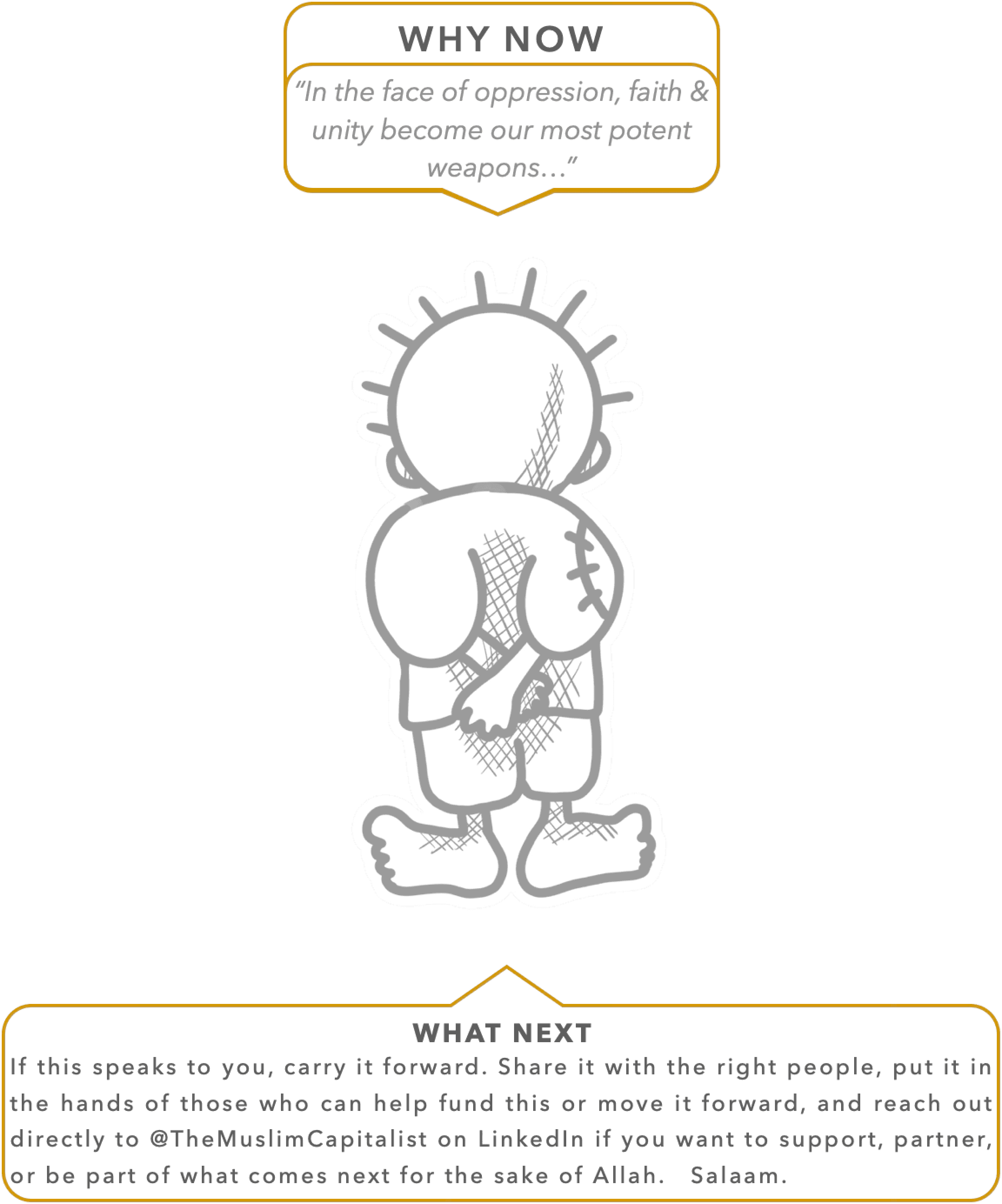
We are not lacking outrage.
We are lacking infrastructure.
We are not lacking numbers.
We are lacking coordination.
We are not lacking potential.
We are lacking the rails to turn that potential into power.
The question is no longer whether fragmentation is weakening us.
The question is no longer whether technology now shapes relevance, security, and power.
And the question is no longer whether the Ummah needs trusted infrastructure of its own.
The only question left is this:
Will we continue renting our identity, our reach, our relationships, and our relevance from others, or will we finally begin building rails of our own?
For mosques: anchor trust where it already lives and become a station.
For investors: help build the rails.
For builders: help architect the future.
For the Ummah: stand together, and change the condition.
Not outrage. Infrastructure.
Not dependence. Ownership.
Not extraction. Recirculation.
Not fragmentation. Coordination.
Usman W.
Managing Partner and Architect
of NexusG8 & Mecca Digital
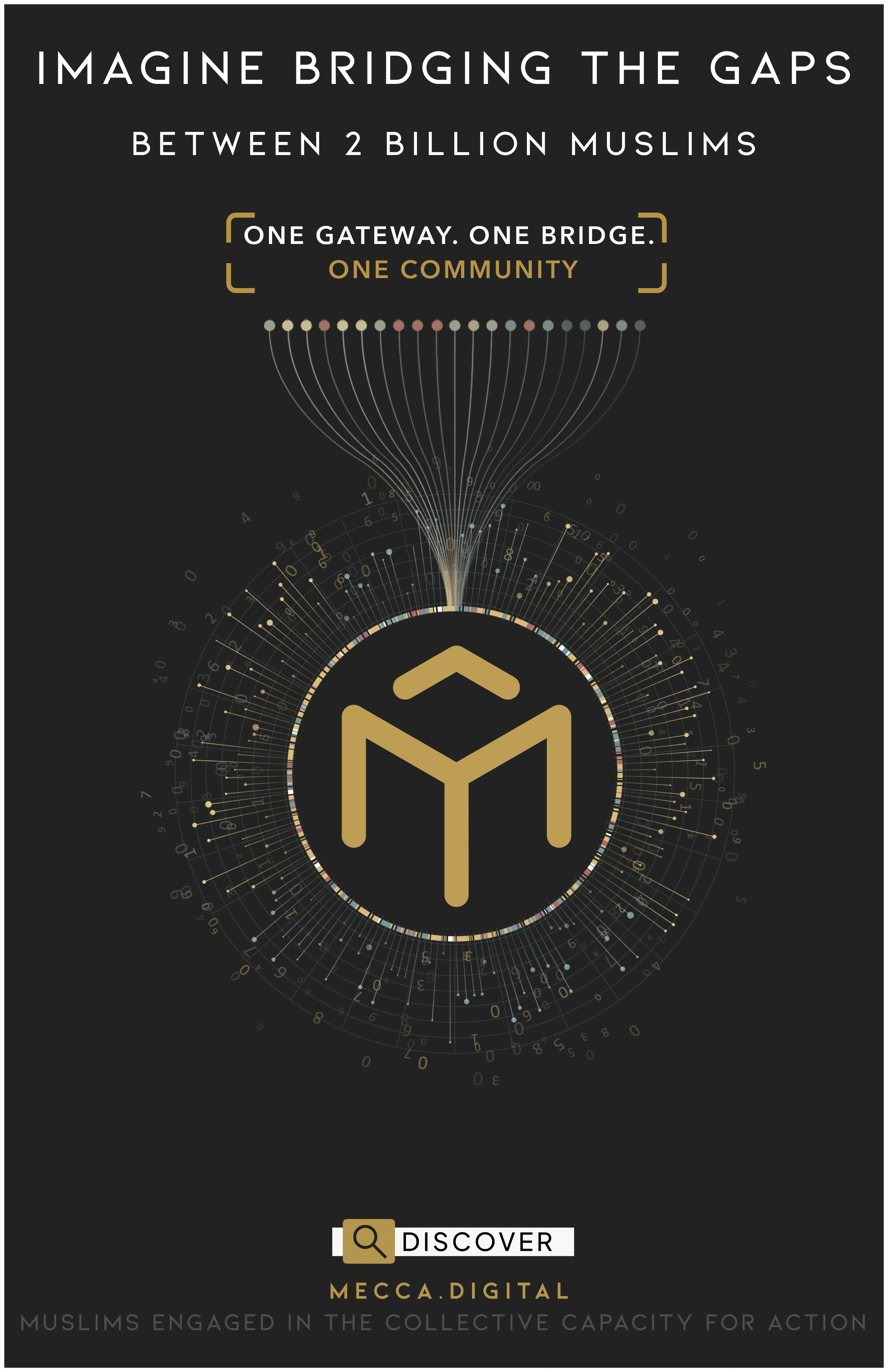
It's Time For Change.
Contact us to take part in the worlds first Islamic-Community-Infrastructure-As-a-Service.