

01
Attention extraction
Our attention is captured, monetized, and used to train systems we don’t own.
$838M+
per year
- Endless scrolling
- Algorithmic manipulation
- Behavioral profiling
- Addictive design
 The Muslim Capitalist
Read the report
A civilizational report · 2026
Humans. Not h@ndles.
A blueprint for reclaiming sovereignty in the age of digital dependency.
I · The current condition
2B+
Muslims, a quarter of humanity, across 55+ countries1
Never before have Muslims been more digitally connected. Never before have Muslims been more fragmented.
“A people without an address can never become a network.”
II · The diagnosis
Every point of light is 1,000 community nodes: mosques, schools, businesses, charities, professionals.
The report estimates 6,105,000+ of them.
This is how many can actually be seen: 1,247.
Less than 1% visible. Roughly one in every 4,900.2
The report estimates more than 6,105,000 community nodes across the Ummah. Only 1,247 were detectable: less than one percent visibility.
The research
Five years of field research, 2020 to 2026, across twelve countries and five layers of community life.
Every room lacked the same five capabilities: identity, discovery, communication, trust and coordination.3
III · The great shift
Each era moved power to whoever owned the rails. Today the rails are platforms, and the Ummah rents them. Its people become handles; its communities become someone else’s asset class.
“The gatekeepers changed. Control never did.”
What we tried
This is not a criticism. It is an acknowledgement. Without shared infrastructure, every effort starts from zero.
IV · The fragmentation tax
Modeled direct annual cost · North America
$225.4M–$450.8M
Every year, in duplicated tools, infrastructure, admin and paid reach.4
Since you opened this page
$0
At the conservative modeled rate of about $7 every second.
Conservative case. 50,000 active organizations, from a baseline of 500,000 Muslim-owned businesses and organizations in the U.S.5
| Component | Conservative | Estimated |
|---|---|---|
| Paid reach, ad spend and customer acquisition | $150M | $300M |
| Administrative duplication | $30.4M | $60.8M |
| Duplicate software and tools | $30M | $60M |
| Duplicate infrastructure | $15M | $30M |
| Total | $225.4M | $450.8M |
$1.03B–$2.06B
A separate benchmark: what one platform is modeled to earn each year from the same audience. About $2.8M to $5.6M a day. Shown for comparison, never added to the total.6
“This is not a spending problem. It’s a routing failure.”
The fragmentation tax, in full
The report’s direct-cost model above counts only duplicated spending. The full bill below adds attention extraction and lost compounding.
Every year, the Muslim community loses
$1.2 Billion+
to fragmentation
01
Our attention is captured, monetized, and used to train systems we don’t own.
$838M+
per year
02
We pay to reach Muslims on platforms that already profiled and profited from them.
$250M+
per year
03
Fragmentation prevents us from building on each other’s work, relationships, and resources.
$186M+
per year
The hidden multipliers
Total financial loss / year
Rounded. Inefficiencies not counted.
≈ $1,274,000,000+
NYT study: Islam was portrayed more negatively than cocaine. Negative narratives compound when we don’t own distribution.
This is not a funding gap. It is a system design problem.
We don’t need more money. We need our own rails.
V · The infrastructure theory of civilization
The first act was infrastructure: a mosque and a marketplace. One for the soul of the community, one for its circulation.
Endowments that built hospitals, schools, wells and roads, and kept serving long after their founders.
More than twelve centuries after Medina, a railway to bind the Ummah’s cities, built with the community’s own contributions.
Shared digital infrastructure the Ummah owns: identity, discovery, communication, trust and coordination.
“No civilization remains sovereign while permanently renting its most important infrastructure.”
VI · Building the missing layer
Ten interdependent layers, built one at a time, each resting on the one beneath. Remove the foundation and nothing above it holds.
“Metcalfe explains why networks become valuable. The Meccan Protocol explains why communities become powerful.”
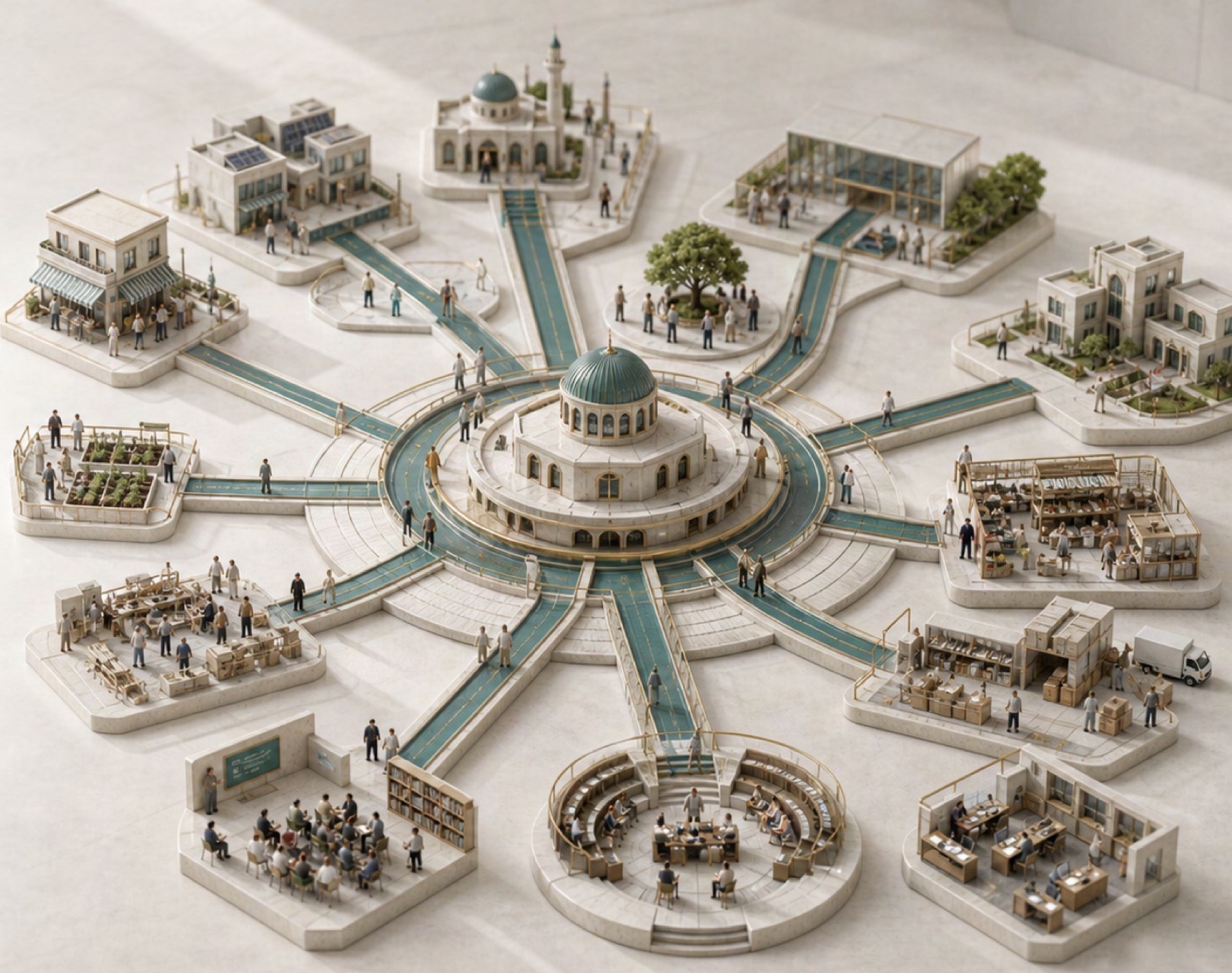
VII–VIII · The organized future
100 organizations spending $5,000 a month hold $500,000 of monthly purchasing power. A 5% negotiated saving returns $300,000 a year.7
We do not need to become one company to negotiate like one.
A trusted, verified channel the community owns, so the right message reaches the right people without renting an algorithm.
Founders launch into shared reach instead of starting from zero. Cooperatives, events and services share one set of rails.
Charitable giving, member capital and regulated investment, routed through infrastructure the community governs with amanah and shura.
Communities create value. Infrastructure determines who keeps it.
Inside the report
The report
The full State of the Ummah 2026: 186 pages, free to read and share.
The briefing
AI-generated audio
An AI-generated audio briefing, for those short on time: the report’s argument in 14 minutes.
Send it to three people who care about the future of the Ummah.
Bring your capital, expertise, institution, network or partnership.
Support the buildإِنَّ ٱللَّهَ لَا يُغَيِّرُ مَا بِقَوْمٍ حَتَّىٰ يُغَيِّرُوا۟ مَا بِأَنفُسِهِمْ
“Indeed, Allah will not change the condition of a people until they change what is in themselves.” Qur’an 13:11
See the condition. Share the blueprint. Help build the answer.